
Casual vs Intentional Dating: What It Looks Like in Practice
Casual and intentional dating are different structures, not moral tiers. Here's how each behaves in practice and how to name the one you're in.
11 min read
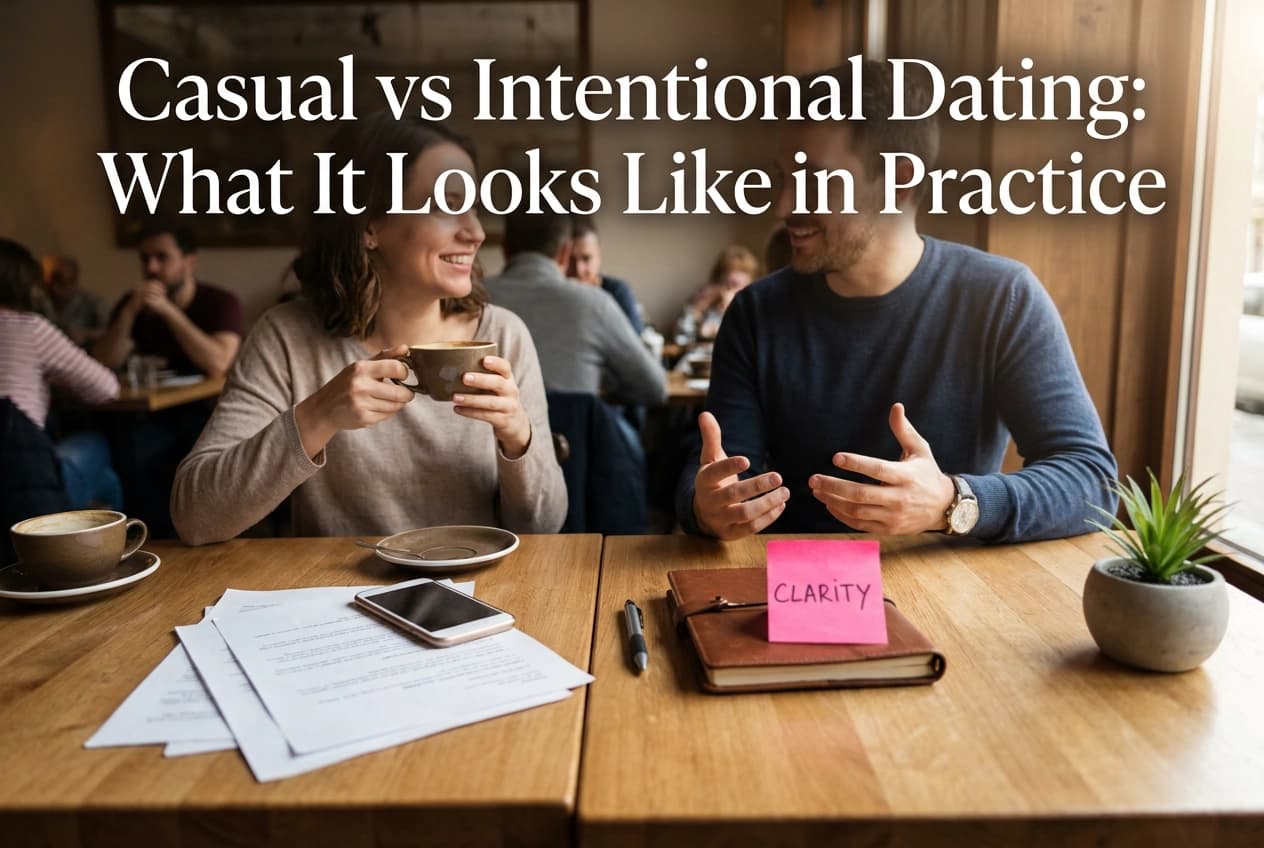
So you're texting someone, hanging out, maybe hooking up, and you're not sure what this actually is. Meanwhile they seem totally chill, or maybe way more serious than you expected. That gap is where most confusion lives, and it usually isn't about someone being good or bad at dating. It's about two people running different structures. Most student frustration comes from that mismatch, not from casual dating itself. This post breaks down casual dating vs intentional dating in plain terms, with zero lectures. Casual dating optimizes for optionality; intentional dating optimizes for fit. Neither is the villain. We'll cover what people mean by casual dating, what intentional dating looks like in practice, why the real difference is structure rather than morality, and four things that actually differ. You'll also learn how to tell which structure you're running, how to name it without making it weird, and how to find people who want the same thing. If you've ever left a hangout more confused than before, this one's for you.
What People Actually Mean by Casual Dating
Research doesn't treat "casual" as one thing. A 2017 study in the Journal of Sex Research split it into three distinct categories: casual dating, friends with benefits, and booty calls or one-night stands. The sample: 192 people, 80% female, mean age 22.09, mixing college students and non-college-attending emerging adults.
Partner type tracked how people rated the experience. Those with casual dating partners evaluated it more positively, or at least less negatively, than those in booty call or one-night stand arrangements.
In practice, casual dating usually means repeated dates, some genuine getting-to-know-you, physical involvement often present, and no stated commitment on either side. Someone still has to plan the actual date.
Casual sexual relationships and experiences are common among emerging adults, so casual is a normal campus default, not a warning sign.
Last caveat: the word means different things in different friend groups. Ask what someone means instead of assuming you already know.
What Intentional Dating Means, in Plain Terms
Quick honesty note: no academic source formally defines "intentional dating." Pew's dating research sorts people into committed relationships, casual dates only, or either, but never uses the phrase. So we're setting the definition here, not citing one.

Intentional dating means knowing what you're looking for and making choices that move toward it, instead of letting a connection drift wherever it drifts. An intentional relationship is one where both people have said out loud what they want and are actively building toward it, even if what they want is still getting figured out.
Here's what it doesn't mean: intentional doesn't automatically mean serious, exclusive, or marriage-tracked. It means named, chosen, and consistent. It can look like going on fewer dates on purpose, or dating several people while being transparent about it with everyone involved.
Quick line to remember: casual runs on possibility, intentional runs on direction. And the gap between the two isn't moral, which is the part people get wrong.
The Real Difference Is Structure, Not Morality
Here's the honest version: casual dating optimizes for optionality, intentional dating optimizes for fit. Both are rational. They're just answering different questions.
Optionality buys flexibility. Low sunk cost, room to explore, no explanation owed to anyone. On a shared campus, that freedom is real, though it's also why dating in a place like Ann Arbor feels different from dating strangers in a city.
Fit-orientation buys information: whether this specific person actually works for you long term, which only shows up over time and consistency. That's the logic behind campus matchmaking over endless swiping: fewer options, more signal.
Neither is more evolved. The maturity ranking where intentional is grown-up and casual is a phase to outgrow? That's cultural, not empirical. No study measures "maturity." US universities run dedicated research programs on casual and romantic relationships in college, and the work spans roughly two decades, from the Online College Social Life Survey through its current wave running through 2026.
You're not choosing between being a good person and a bad person. You're choosing which question you want answered right now.

Casual Dating vs Intentional Dating: Four Things That Actually Differ
Here's where the two structures actually show up in practice. Four axes matter most, and none of them come with a scorecard.
Expectation setting. Casual usually leaves the terms implied and lets them settle by vibe. Intentional names them early, even when the answer is "I'm still figuring it out."
Exclusivity. Casual defaults to undefined and tends to stay there. Intentional makes an explicit call and revisits it when things change.
Time investment. Casual is low-commitment and reactive, with plans made hours ahead. Intentional is steadier, with plans made days ahead and actually held.
Communication. Casual often routes around the "what are we" talk. Intentional schedules it, sometimes awkwardly, on purpose.
None of these axes is automatically good versus bad. Casual can feel light and fun in one pairing and anxious in another. Intentional can feel secure in one and pressured in another. Context shifts it too, which is part of why dating in Austin looks different from dating in a small college town.
But these four are where mismatch shows up first. Worth watching, not moralising.
Why Casual Isn't the Villain
None of that means casual is bad. Casual dating has real upsides: room to figure out what you actually like, low pressure while you're getting over a breakup, and a low-stakes place to practice saying what you want.
Research backs the "not the villain" read. A review of 71 studies found people rated their casual experiences more positively than negatively, and outcomes varied a lot across people and situations. That diversity, not casualness itself, is the likely reason some people thrive and others struggle.
The harm usually comes from vagueness and mismatched expectations, not from the category. If you both want the same thing and both actually know it, casual is a healthy, functional structure. Not a placeholder, not a waiting room.
There's a lot of moralizing about casual dating and very little evidence the panic is deserved. That doesn't make intentional dating the "correct" choice either. Both are structures. Neither is a personality.
The Mismatch Problem: When Two Structures Meet and Nobody Names It
Here's the argument this whole piece is making, and it's the article's logic, not a research finding: most of the pain isn't either structure. It's two people running different ones.
The pattern is common. One person reads good mornings, weekend plans, and steady texting as commitment. The other reads the same behavior as normal, pleasant dating with no forward claim.
Watch for the warning signs: different texting cadence, different reactions to meeting friends, different assumptions about planning ahead, different energy when the "what are we" question surfaces.
People dodge naming it because saying it out loud feels like asking for more than you're allowed to ask for. Silence feels safer in the short term.
Then the bill arrives. Resentment stacks quietly, then releases all at once. One person experiences betrayal, the other an ambush.
Campus makes this messier, since the same people keep showing up in your dining hall and your 8 AM, which is exactly why campus-only matching changes the equation.
The fix isn't choosing the better structure. It's surfacing the one you're both actually running.
What Being Intentional in a Relationship Actually Looks Like
So what does intentionality actually look like on a random Tuesday? Basically this: you can say what you want and why, out loud, without the "whatever happens, happens" shrug. If you can't describe it, you're not running it yet.
Checking in beats guessing. Something like "I like where this is going, are we on the same page?" is enough. Intentionality also shows up in calendars before it shows up in feelings: make plans instead of waiting to be asked, whether it's dinner Thursday or something two weeks out.
Saying no early to someone who wants a different structure is a kindness, not a rejection. And when they tell you what they want, treat it as information, not a character flaw. A mismatch is a compatibility fact, not a moral verdict.
The best part: being intentional in a relationship isn't a personality trait you're born with. It's a behavior you repeat. Which means it's learnable, starting with your next conversation.
What Casual Dating Looks Like When It's Done Well
Intentional or not, casual works best when it's actually named. Both people should be able to sum it up in one sentence, even if that sentence is "we hang out, we're not exclusive, and we like it that way." No fake escalation: nobody dangles a future they don't plan to deliver just to keep someone around. Physical boundaries and safer sex practices get said out loud, not assumed. And when someone wants something different, it ends with a real conversation instead of a slow fade.
The through-line: casual describes the level of commitment, not the level of care. Kindness isn't exclusive to intentional dating. Campus culture shifts this too, and what makes dating in Baton Rouge different? is a good example of how local norms change what "casual" even sounds like. Which is why it's worth checking which structure you're actually running before the next conversation.
How to Tell Which Structure You're Actually Running
If casual can be done well, the next question is simpler: which structure are you actually in?
The dating-someone-else test. Picture them telling you they're seeing someone else. Relief points one way, a stomach drop points the other.
Friend check. Do you know their friends' names, and do they know yours? Mutual social integration is one of the clearest signals of a steadier structure.
Planning pattern. Days-ahead plans suggest something intentional. Same-day texts suggest something looser.
Avoidance check. Are you dodging a conversation you know you need to have? Avoidance is usually evidence about which structure you're already running.
Here's the honest audit: the structure you're in is the one your behaviour shows, not the one you'd claim if someone asked. So do this check before the next conversation, not after it. Naming it starts with knowing it.
How to Name It Without Making It Weird
Once you've run that audit, the next step is saying it out loud. You don't need a script, just one sentence.
Pick a low-stakes moment. A walk, a hangout, a Tuesday. In person beats text, and definitely avoid 1 a.m. or the middle of an argument.
Use an "I" statement about your own position: "I'm looking for something with a bit more direction than this." Then hand them an easy exit: "Totally fine if that's not what you want, I'd just rather know."
Whatever comes back is data. A mismatch is compatibility information, not a verdict on your worth.
Do it earlier than feels comfortable. The longer you wait, the more the conversation starts to feel like a referendum on the whole thing instead of one question.
And yes, it will be awkward. It's awkward for basically everyone. Awkward isn't the same as wrong.
Finding People Who Want the Same Structure
Naming it works. The cleaner fix is upstream: meet people whose stated intentions already line up with yours, before the first date instead of three months in.
Ditto is one path there. It matches verified college students on your campus by values and preferences, not looks alone, and sends one curated match every Wednesday at 7 PM. Each match comes with a date plan covering time, place, and match details, which kills the fog around whether a hangout is actually a date.
Honest caveat: no app runs the naming conversation for you. Tools just make it likelier you're starting from the same page. If you already know you want a structure with more direction, it's worth a look. We think connection deserves better. The FAQ has the details if you want them first.
The Takeaway
Casual optimizes for optionality. Intentional optimizes for fit. Both are legit structures, and neither one makes you the villain.
So do three things: name your own structure honestly, ask the other person to name theirs, and act on the answer instead of negotiating with silence.
Casual isn't the problem. Unnamed mismatch is what actually hurts.
You already know which conversation you've been putting off. Go have it this week.
Conclusion
Casual dating and intentional dating are both valid structures. The real difference is not morality; it is what each one optimizes for: optionality or fit. Most pain comes from unnamed mismatch, not from either structure itself. So name your own structure honestly, ask the other person to name theirs, and act on the answer instead of negotiating with silence. That conversation is awkward, but it is also clarifying. If you want to start upstream, meet people whose intentions are visible from the beginning. Ditto can help with that. Then still have the human conversation. You already know which talk you have been putting off. Go have it this week, and choose clarity over guessing.