
How AI Matchmaking Picks Your One Match Every Week
Curated AI matchmaking hands you one campus match each week, with a time and a place attached. Here's how the one-match-per-week system actually works.
11 min read
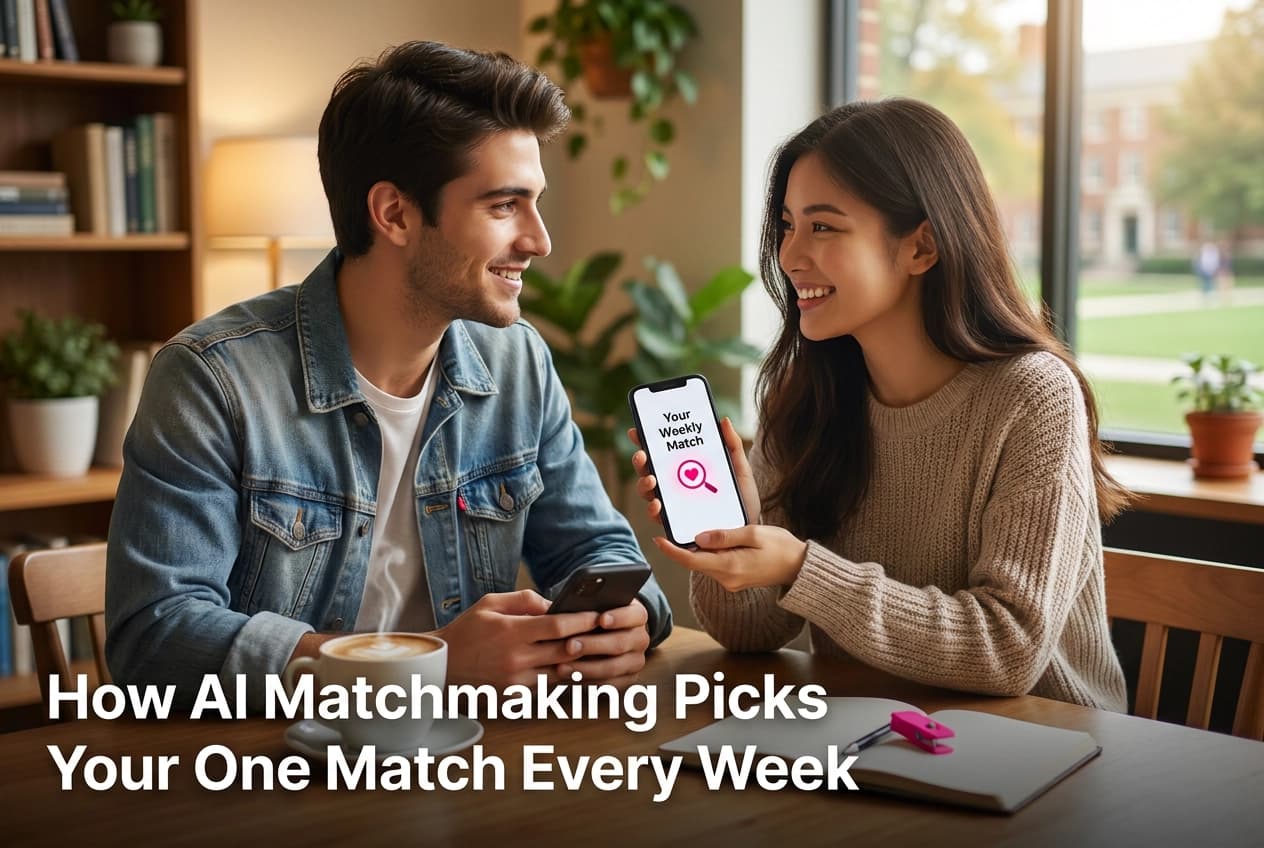
You open the app and see exactly one person. No endless grid, no swipe marathon, no "maybe later" pile. That is the strange little promise of a curated ai dating app, and it is the whole point of How AI Matchmaking Picks Your One Match Every Week. Instead of optimizing for more matches, it optimizes for one date that actually happens. In this post, we'll break down how that works for beginners. We'll start with why Gen Z is lonelier and more done with dating apps than anyone, then explain what an ai dating app means by one match a week. You'll see step by step: the intake, the matching window, and the Wednesday 7 PM drop. From there, we'll dig into why the constraint is the feature, tackle the obvious objection about low supply, and land on the final idea: one match, one planned date. If that sounds like less, keep reading. Less might be exactly what makes it work, especially when that one match arrives with a time and a place attached.
Gen Z Is Lonelier and More Over Dating Apps Than Anyone

Gen Z is reported to be the loneliest generation yet, and college students report the greatest disillusionment with dating apps of any group. Those two things are connected. Loneliness is serious enough that the U.S. Surgeon General declared it an epidemic, with about one in two American adults reporting it.
The fatigue isn't a vibe, it's specific. People describe mindless swiping, profiles that feel like performances, and matches that fizzle before anyone actually meets. Whether you're searching for the best dating apps in Athens or just judging the whole category, the complaint follows you around.
But the demand never left. Nearly half of Americans still name dating apps as a top place to meet someone. We didn't stop wanting to meet people. The format wore us out: infinite options, all the effort on you, nothing ever scheduled.
That's also why campus matchmaking beats swiping for people who already share classes and dining halls. The pool is smaller, but it's real.
So flip it. If volume is the problem, maybe fewer matches is the fix. Not fewer because nobody's out there, but fewer because each one has way more behind it. One that shows up with a person, a time, and a place instead of a maybe.
We'll walk through exactly what happens between signing up and one match landing on a Wednesday night.
What an AI Dating App Means by One Match a Week
An AI dating app in this format does something almost radical: it generates a small, deliberate number of matches for you instead of an infinite queue you sort through by reflex. Curated means the system picks using what you said matters to you, rather than handing you a deck to swipe until something sticks.
One match per week is a cadence, not a shortage. Cadence is a core design decision in this space, and the model is often called enforced scarcity on purpose. Formats range from a single annual match after a long questionnaire to multi-week runs to a fixed weekly drop. Ours is the weekly kind.
The pool is verified college students at your own campus, which keeps matches real and local instead of geographically optimistic. It's a big reason campus-only matching changes the equation.
Then the mechanics. Ahead: intake, where you tell the system who you are and what you want; the matching window, when it weighs your answers against everyone else on your campus; and the Wednesday 7 PM drop, which arrives with a time, a place, and match details. Three steps, one name, one plan.
Step 1: The Intake, or What the System Actually Asks You
Before any matching happens, there's the intake. Two inputs matter here, and they aren't the same thing.
Values describe who you are: what you care about, how you spend a free Tuesday, what you won't compromise on. Preferences describe who you'd want to meet. A good system asks for both and treats them differently, because you're more than a list of wants.
Then there's honesty, which is the whole game. If the system weighs what you said matters to you, then filling out the intake to look cool gets you a match built on a costume. People are already wary of overpromising matching tech anyway. In a 2025 Boston University survey, more than twice as many respondents disagreed that AI in dating apps would lead to more successful relationships as agreed. That skepticism is earned, and performative answers only hurt you.
Verification is simpler than it sounds. Confirming you're an actual student at your school keeps the pool to people you could genuinely run into between classes.
You don't need the algorithm vocabulary here. Your answers become signal, compared against real profiles on your campus instead of sitting in a void.
One honest caveat: no questionnaire is perfect. Your Personalized Matchmaker is chasing a strong signal, not handing down a personality verdict.
Step 2: Inside the Matching Window
Doing the intake honestly is step one. Step two is the quiet part: the matching window, the stretch between the answers you submitted and your Wednesday drop.
Nothing Happens on Your Screen
There's no feed to refresh and nothing to swipe. While you go to class, the system is comparing what you said against everyone on your campus who filled out the same intake. You don't see it, and that's normal. Matching is supposed to work in the background.
Filtering, Not a Popularity Contest
This isn't a leaderboard. You're not ranked by likes, followers, or how fast you reply to a text. Nobody is tallying how "in demand" you are. The system weighs fit instead: how your values and preferences line up with someone else's, in both directions. Research on over 421 million potential matches found that alignment on shared traits predicts mutual interest far better than anything resembling a hotness score.
Density Beats Raw User Count
Here's the part people skip. A few thousand students at one school makes a deeper pool than 100,000 users scattered across the country, because a match has to be someone you can actually run into. And that density builds fast: one campus crossed 1,500 signups for a curated matchmaking run within weeks.
The Constraint Adds Pressure
Density doesn't make the job easier. It makes it stricter. Because the output is one name, the system can't hedge across ten maybe-matches. It has to commit.
So the match you get isn't the leftovers of a thin pool. We think connection deserves better. One output is a deliberate narrowing, not a system running out of options.
Step 3: The Wednesday 7 PM Drop
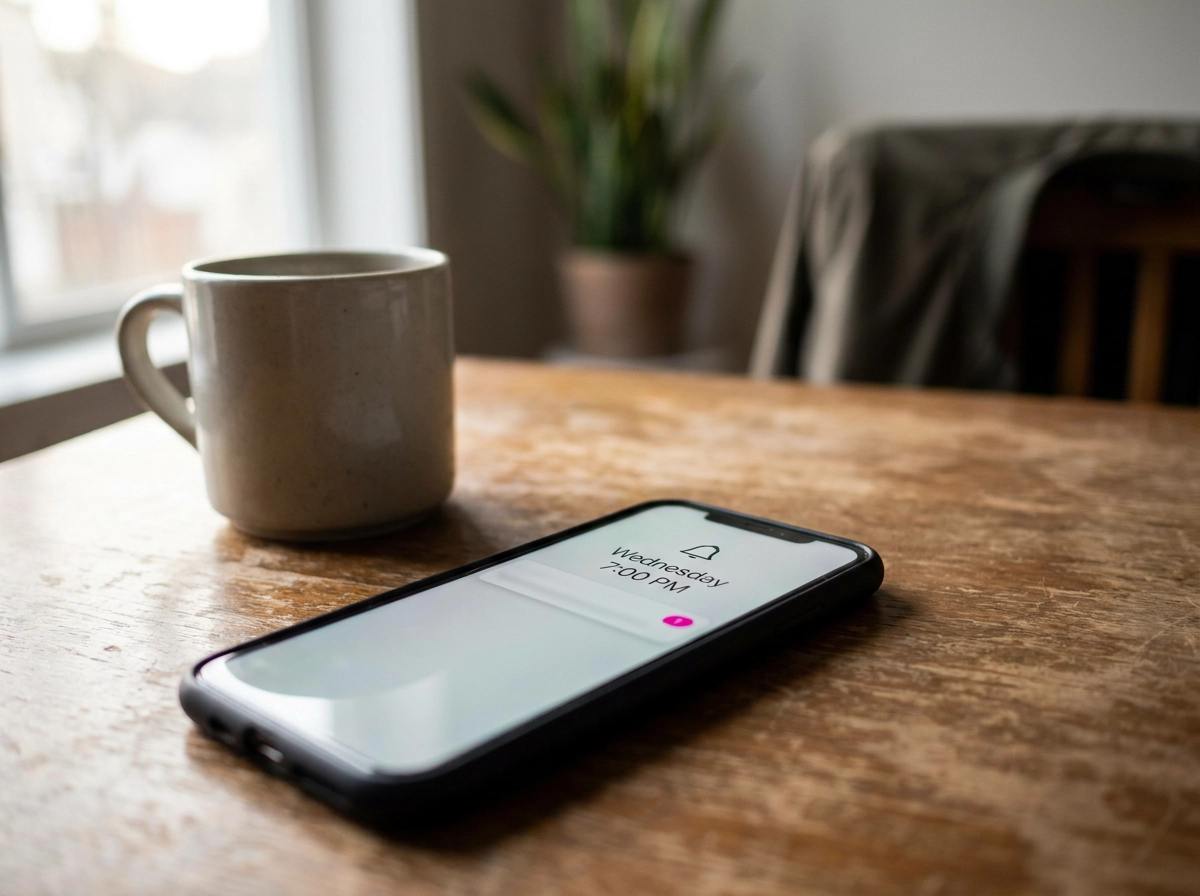
Then the narrowing lands. Every Wednesday at 7 PM, you get one match: a verified student from your campus, and nothing else to scroll.
What actually arrives
Not a name and an empty chat box. The drop comes with a date plan attached: a time, a place, and details about your match, so the only thing left to decide is whether you're showing up.
That's the part that matters. The vague back and forth about whether and when to actually meet is where most matches die. You both mean to, then someone gets busy, then the thread goes quiet. A plan deletes that step entirely. There's nothing to negotiate, so there's nothing to stall on. No "so... when are you free?" spiral, no match rotting in your inbox for three weeks.
A ritual, not a chore
Weekly drops also flip your relationship with the app. You're not maintaining a queue that never empties; you're waiting on one thing, one night a week. Wednesday becomes something you check for, not something you owe. That's a totally different feeling from opening an app because there might be something new and closing it because there isn't.
For the full picture of how that match gets built, from intake through the drop, see how Ditto works.
And that's the format argument in miniature. One match, one notification, one plan. Small, scheduled, finished. The drop doesn't try to hold your attention; it tries to get you off your phone and across campus. That's the whole point.
Why the Constraint Is the Feature
Now zoom out, because the two formats are playing different games. Volume optimizes for time spent in the app: more browsing, more sessions, more hours. A single match optimizes for a date that actually happens. One scoreboard counts minutes. The other counts meetups.
Endless options carry a real cost. Research on choice overload, starting with the classic jam study, found that shoppers shown 24 varieties were far less likely to buy than shoppers shown 6. More options meant more effort to decide and more room to regret the pick. Dating is a harder call than jam, so the effect can bite harder: a full deck raises the odds you choose nothing at all.
Scarcity by itself can read as low supply. Scarcity plus certainty reads as intent. One match with a real person, a real time, and a real place is the opposite of a dead-end match you have to coax into existence with three days of "so... when are you free?"
And to be straight with you: this is what the format is designed to optimize for, not a stat anyone has measured. There's no peer-reviewed proof yet that one match per week produces more actual dates than swiping does. That's the design goal, and it's the number worth watching.
The trade, in one line: fewer decisions, one action.
The Obvious Objection: Isn't One Match Just Low Supply?
Fair criticism? Kind of. Curated matchmaking has shown up on some campuses and been met with shrugged shoulders and low expectations, and that skepticism is earned rather than cynical.
Where the objection falls apart is what comes attached. Scarcity reads as low supply when a match arrives with nothing but a name. A match that arrives with a time and a place reads as intent instead. Researchers who study mobile dating define "effective matching" as getting to the point where two people actually plan to meet in person, which is the standard most swipe formats never bother aiming at. It's also why the plan matters so much on a first date: planning is the friction that quietly kills more connections than incompatibility does.
The pool is clearly there, though. More than 1,500 students signed up at a single school even with low expectations floating around. That's density, not a shortage, which means a one-match cap is a design choice rather than the system running dry.
And here's the honest part. There's no published data yet on how many curated matches turn into actual dates. That's the number to watch, and it's the only one that truly settles this argument.
So judge any one-match format with one test: does it end in a plan, or does it end in a notification? A notification says someone exists. A plan says someone intends to show up.
One Match, One Planned Date
You already have the test: does it end in a plan, or a notification?
The narrow output isn't a limitation to work around. It's the design that makes the output usable. One name you can act on beats fifty you can't.
So reset the scoreboard. Judge an AI dating app by the dates that actually happen, not the hours you log or the size of your match list. A match list is inventory. A date is a result. Wondering how campus density plays out school by school? A look at the best dating apps in Ann Arbor shows why a deep local pool matters more than a big national one.
If your campus has a curated matchmaking app, your next step is small: sign up, fill the intake honestly, and show up on Wednesday at 7 PM. The answers you give are the entire product, so the version of you that answers is the version of you that gets matched.
Then one rule: say yes to the plan. One match plus one time plus one place beats a hundred threads that never leave your phone.
Conclusion
AI matchmaking flips the dating-app scoreboard. One curated match a week is not low supply; it is a deliberate constraint that turns attention into action. Your intake answers shape who you meet, the Wednesday 7 PM drop creates a clear moment to decide, and the real metric is not matches or messages but plans that happen. So if your campus offers a curated app, sign up, fill out the intake honestly, and show up Wednesday at 7 PM. Then say yes to the plan. One match, one time, one place beats a hundred dead threads. Treat the notification as an invitation and the date as the result. Your next real date may start with one honest answer and one yes.