
How to End a Campus Date Well, Whether or Not You Want a Second One
Learn how to end a campus date well, whether you want a second date or not. Clear, kind scripts that protect your shared campus circle.
11 min read
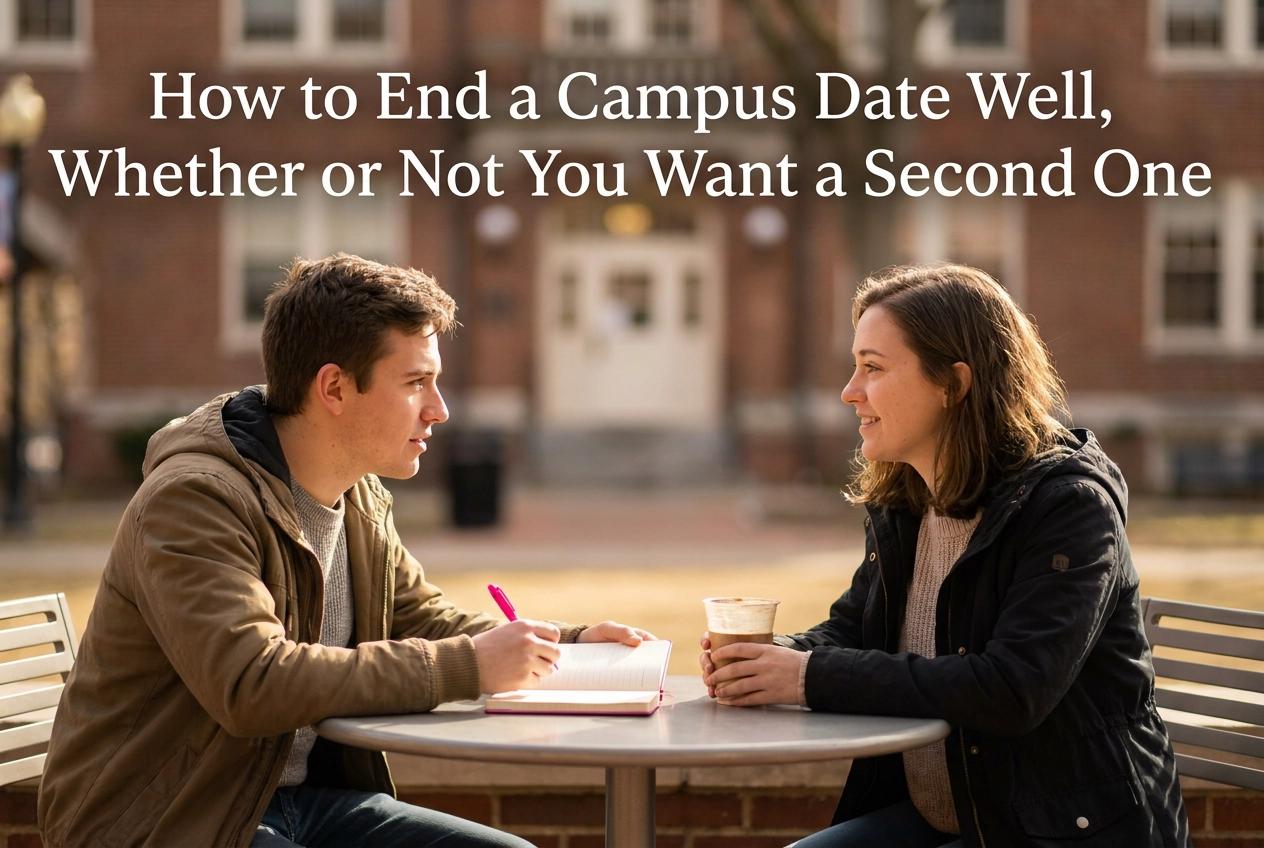
The last ten minutes of a campus date can feel way more stressful than the first ten. You’re standing outside the dining hall or walking back to your dorm, and suddenly you have to answer one giant question: what now? Do you ask for a second date? Do you say you had a nice time and disappear? Do you just… keep walking?
Here’s the good news: you don’t need to be smooth. You need to be clear and kind. If endings feel awkward, you’re statistically in good company, more on that below. This post walks you through how to end a campus date well, whether you want a second one or not. You’ll learn why the last ten minutes matter so much, how to decide what you want before the date, what to say in both scenarios, how to handle timing, place, and body language, what to do when the answer isn’t what you hoped, and quick exit scripts you can steal. Let’s make the ending the easy part.
The Last Ten Minutes Are What the Date Becomes
The ending is the part both people replay, retell, and remember. Not the appetizer, not the small talk. A great date with a messy exit reads as a bad date, full stop.

And exits are hard for a lot of people. In IFS's State of Our Unions 2026 report, only 34% of young adults said they feel confident discussing feelings with a dating partner, and just 36% feel confident reading social cues on dates. So if the last ten minutes feel scary, that's common, not a personal failing.
The downstream cost is real too. Only 28% said they can stay positive after a bad date or relationship setback, and 55% said past breakups made them more reluctant to start new relationships (IFS, 2026). Sloppy endings likely feed that exhaustion.
Here's the reframe: a clear answer, either direction, is information, not judgment. It lets both people plan their week and stop guessing. That's a kindness, and it also makes it easier to figure out where a second date should go.
One honesty note before we go further: no research actually studies how people end dates. Everything below is practical guidance, not a study finding.
Why a Campus Date Needs a Different Kind of Exit
Campus changes the maths here. There's no campus-specific data in the research on dating exits, so treat what follows as a shared-circle argument, stated plainly rather than dressed up as a stat.
The recurring-character problem. On a campus, there's no clean break available. That person sits two rows over in your psych lecture, eats at the same dining hall, might run the club you're thinking of joining, or shares a friend group with you. You will see them again, probably soon.
The rumour math. A clumsy or unkind exit gets retold through a friend group way faster than a great date ever does. Whatever you do in the last ten minutes is, functionally, public.
The re-entry effect. A respectful ending, even a rejection, keeps both people willing to say yes to someone else later. Dating resilience gets built one exit at a time. A harsh one teaches someone that dating isn't worth the risk.
That's the whole angle: the exit is the skill that keeps students dating, because people only take risks when the failure mode is survivable. Lower-pressure formats help, like why double dates are the lowest-pressure way to date, but the exit is what makes you willing to try again.
Decide What You Want Before You Walk In
Good news: the exit is way easier when you've already made the call. Make it before you leave your dorm.
Pick your honest answer: yes, no, or genuinely unsure. All three are fine. Then decide what "unsure" sounds like out loud, so you're not inventing language on the spot. Something like, "I'd be up for hanging out again this week, I'll text you."
If you're in the unsure camp, don't panic. Singles willing to try a second date after a first that wasn't exciting rose from 35% in 2021 to 41% in 2026, per the Kinsey Singles in America survey (funded by Match). Lukewarm isn't automatically a no.
Knowing your own boxes speeds this up: singles keeping a checklist for a long-term partner rose from 25% to 34% over the same stretch. Nail down the two or three that actually matter, and the call gets quicker in the moment.
Then lock the practical stuff. Set a soft end time (practice, a lab report, an early class) so leaving early is a plan, not a verdict on the person across from you. Settle your walk-home and money plans before you go, so neither becomes a negotiation at the door. The best first-date ideas for Canadian college students help here, since a set plan makes for a set ending.
Ending Well When You Do Want a Second Date
You decided yes before you walked in. Now say it before you walk away.
Be specific about what you liked. "I had a really good time" is fine, but "I liked that you actually had opinions about the reading" gives them something true to hold onto. Specific beats smooth every time.
Name a concrete next move, not a vibe. "I'd do this again, want to grab coffee Thursday?" beats "we should hang out sometime," which on a campus where you will absolutely see each other again reads as a polite brush-off. A day and a plan is a real answer.
Say it in person, at the natural end of the date. The last ten minutes exist for exactly this. A text an hour later wastes them.
If you're only curious, say that. "I'd be up for hanging out again this week" is honest and doesn't promise a relationship you haven't decided on. And if what you liked was how they think, Shared Values in College: Why a Match Is Only Step One is worth a read. A second date is one small decision, not a verdict.
Then close the logistics and go. Clear beats clever. If it's not a yes, the next exit needs the same clarity.

Ending Well When You Do Not Want a Second Date
The no side takes the same ten minutes, just a different line. Here's how to land it without awkwardness.
1. Say the short line. "This was nice, but I don't think we're a match." That's complete. It's kind, it's clear, and it doesn't owe anyone a follow-up explanation. Resist the urge to pad it.
2. Do it in person, at the end. Not a text three days later. Ghosting is the thing people remember and repeat, and on a campus it's the thing that follows you into the dining hall.
3. Keep it about fit, not a critique. Don't rank what went wrong or offer a performance review. A clean no turns into an insult the second it becomes a list. If you're sorting out what actually mattered to you, Deep Questions That Surface Shared Values on a Date can help you spot fit faster next time.
4. Skip the fake friendship. Only offer "let's be friends" if you genuinely mean it. A softener that isn't real puts them back in limbo, which is worse than a real no.
5. Close the logistics. Thank them, split the cost if that was the plan, and follow through on whatever walk or ride you arranged. No vanishing between the bill and the door.
One sentence said, nothing left dangling. That's the whole job.
The Mechanics: Timing, Place, and Body Language
Once the words are out, the last few minutes are pure logistics. Here's how to land them.
End at the plan's end. Finish when the plan finishes, not mid-bite and not whenever the server wanders past. The last ten minutes should be a real ending, not a vanishing act between the bill arriving and the door. Choosing a weeknight date with a real start and end time gives you both a built-in finish line.
Stand up, go outside. Say it standing, outdoors, with an easy exit available to both people. A parked car or a corner booth turns a simple goodbye into a trapped conversation.
Warm tone, direct eye contact, no nervous laughing. One clear sentence delivered kindly beats five hedged ones that add up to nothing.
Sort the walk home out loud. Offer, accept, or decline in plain words. Ambiguity at the door is where half of campus awkwardness is born.
If you're the one being walked home, a simple "Thanks, I had a good time tonight" at the door is a complete ending. You don't owe anyone an invitation inside or another plan.
When the Answer Is Not What You Hoped
Sometimes your line lands and the answer isn't the one you wanted. Maybe you got a no. Maybe you got a yes and you're the one still unsure.
If they say no, the winning reply is short: "Totally get it, thanks for being straight with me." That's the whole response. Don't ask why. Don't try to relitigate the date. Curiosity about their reason is normal, but the answer almost never helps, and asking costs you both dignity. You walked in calm; walk out the same way.
Then give yourself the 24-hour rule. No group chat debrief, no posting, no subtweeting for a day. Campus memory is long and screenshots are forever.
Worth remembering too: the other person probably showed up nervous. About 50% of Gen Z say they screen or research a date online before meeting in person (Kinsey), so assume they had their own version of those jitters.
And if you're the one on the fence after a yes? "Let's see how the week goes" is a legitimate answer. You're allowed to be honest about being unsure. That's not a rejection. It's just the truth.
Quick Exit Scripts You Can Actually Steal
You've got your answer. Now here are the words for it. Steal these as-is.
Second date wanted: "I had a really good time tonight. I'd do this again. Are you free Thursday?" Need a plan? Fall date ideas can help.
Not a match: "This was nice, but I don't think we're a match. Thanks for tonight."
Still deciding: "I'd be up for hanging out again this week. I'll text you." Then actually text within 24 hours. That's the whole deal.
Next morning: one short, specific line. "Hey, still thinking about that story about your roommate." No essay, no over-explaining, no apology for having a fine time.
If someone says either line to you, "Thanks for saying that" is a complete and gracious reply. It ends the conversation cleanly, and that's a win for both of you.
The Exit Is the Skill That Keeps Everyone Dating
So that's the whole thing, really. Four moves carry every good ending: decide before you go, say it in person, say it in one clear sentence, and close the logistics so nothing dangles.
On a campus, that's not just manners. You share dining halls, lectures, club meetings, and friends with the person across the table. A clean ending protects your own social life as much as theirs.
And it ripples. A kind no costs ten minutes and keeps both people willing to say yes again, which matters when dating resilience runs low.
It's also easier when the date comes with a plan. Ditto sends verified college students one curated match from their campus every Wednesday at 7 PM, plus a date plan with time, place, and match details. Expectations are set before you meet, so the exit is easier to call. Campus matchmaking in Canada, explained without the hype breaks down how that model differs from swiping.
The last ten minutes aren't the awkward part to survive. They're the part that decides what the date becomes.
Conclusion
Ending a campus date well comes down to a few things: decide what you want before you walk in, say it in person, keep it to one clear sentence, and close the logistics so nothing dangles. On campus, a kind no protects more than feelings, as we covered above. The last ten minutes are not just awkward cleanup; they shape what the date becomes.
Your next step? Before your next date, pick your ending and practice your line. If you want the structured version, Ditto's Wednesday match gives you exactly that. Good endings keep everyone dating.