
What 'Verified College Student' Should Mean on a Dating App
Verification claims are everywhere on dating apps. Here's what 'verified college student' should prove, what it doesn't, and how to check.
11 min read
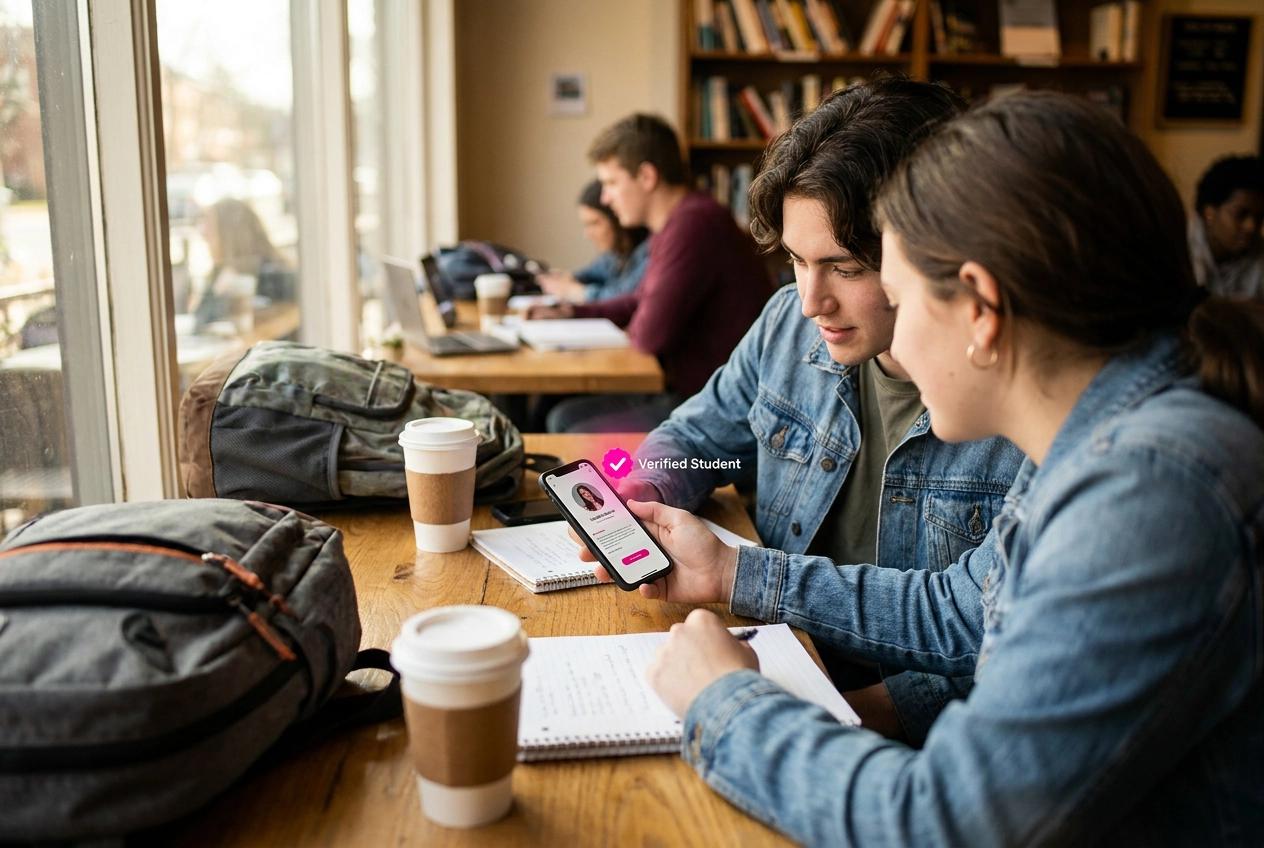
That little "verified college student" badge looks pretty good on a profile. But what does it actually confirm? If an app verifies users while the pool is everyone within 50 miles, you're basically on a citywide app with a college filter. Verification is the difference between a campus pool and a citywide one. The scope and the method are what matter, not the badge.
In this post, we'll walk through why "we verify users" is not a real answer, what a "verified college student" claim should confirm from identity to current enrollment to campus scope, and how to check a verification claim yourself. We'll also look at scam signals verification won't catch, what to ask before you trust an app's badge, and where a campus-scoped pool fits in. By the end you'll know the short version: method and scope, not badges.
Why 'We Verify Users' Is Not a Real Answer
A "verified" badge doesn't tell you much on its own. What got checked? Who checked it? What happens when someone fails the check? Most apps won't say.
Verification claims vary wildly. Depending on the app, "verified" might mean a phone number or email, a selfie that matches your profile pics, or a government ID check. The label covers all of them.
That vagueness matters because scammers build fake profiles, spend several chats earning trust, then ask for money, per the FTC's romance scam guidance. And in October 2026, the Romance Scam Prevention Act was signed into law, requiring dating services to notify users when someone they were talking to gets banned for fraud. That's a legal signal that "trust us" alone was never enough.
So the useful question isn't whether an app verifies people. It's what it verifies and how it does it. Most apps were built for 28-year-olds in cities, not students juggling 8 AM classes, which is why campus-only matching changes the equation.
Next, let's split "verified college student" into three separate claims you can actually evaluate.
What a 'Verified College Student' Claim Should Confirm
Here's the thing: one phrase is quietly doing three jobs.
Identity: is there a real person behind the profile? NIST's digital identity guidelines treat identity proofing as the process for building trust that someone is who they say they are.
Enrollment: is that person currently enrolled at a named school, and when was that last checked?
Campus scope: is the pool actually limited to your campus? An app can run honest identity checks and still drop you into a citywide pool full of people who have never set foot on your school's grounds.
Each layer proves something the others doesn't.
None of the major dating-safety sources we found spell this out, which is exactly why you should make an app name its method instead of trusting a badge. It also helps to know what the FTC's data crackdown means for student dating apps, because verification and data handling usually come from the same place.
Treat "verified college student" as a stack, not a stamp. Check each layer on its own.
Identity: A Real Person on the Other End
Start with identity. It's the narrowest layer: is there a real human behind this profile, and are the photos actually them?
Strength varies. As a rough rule of thumb, a phone number or email proves little, a selfie matched against profile photos proves more, and a government ID check proves more still. So when an app says "verified," ask which one you got.
It's the base layer because the FTC points to fake profiles as a core tactic in romance scams. Stolen photos and bot accounts are the opening move, and everything else a scammer claims sits on top of a fake identity.
But know the ceiling. Someone can pass a selfie check and still be a scammer. Identity verification blocks bots and stolen photos, not bad intent.
It also says nothing about whether your pool is really your campus, which is what shapes your day-to-day. That's part of why campus matchmaking beats swiping for Canadian students, and values-based matching only means something when the people on the other end are real students at your school.
Enrollment: Actually Enrolled Right Now
Identity covers who's typing. Enrollment covers whether they're actually a student right now, at a school you can name.
Enrollment verification should confirm current attendance at a specific institution, not just that someone looks 22 and lives near campus.
Ask what evidence the app accepts, because the levels aren't equal:
A student email domain or .edu address proves access to a school inbox, nothing more.
A current course schedule is stronger.
A school ID with an expiration date is stronger still.
Timing is the sneaky part. Clearinghouse-style records include enrollment begin and end dates alongside a status field, which is how past attendance gets separated from current attendance. Someone who graduated last spring, or dropped out and still hangs around campus, is not a current student.
So if an app can't tell you which school someone is enrolled at, or when that was last checked, 'verified student' is doing basically nothing. Scope is the next layer, and Campus Matchmaking in Canada, Explained Without the Hype only works when the pool really is your school.
Campus Scope: The Pool Is Actually Your Campus
Even a solid enrolment check leaves one question open: is the pool limited to your school, or is it your whole city with a campus filter layered on top?
That difference matters. In a citywide pool, you can match with someone whose campus claim was never checked against any single institution. Nobody confirmed which school, or that they attend one at all.
Scope is what turns a badge into a real signal. The smaller and more specific the pool, the more each verified claim is worth, because fewer unverified people can slip in. A verification check plus a tight boundary beats a check on its own.
Ditto's position is that a verified, campus-scoped pool is the strongest safety signal a student can get. It's worth weighing, but no published dating safety research establishes it, so treat it as an argument to evaluate rather than a proven fact. Ask how that boundary actually gets enforced.
How to Check a Verification Claim Yourself
Campus scope is something you can partly judge from the outside. Testing the rest takes a few minutes.
Read the app's own help or safety page. If it says "verified," hunt for what that covers, what documents or checks are involved, and how often the whole thing re-runs. If it won't spell that out, that's your answer right there.
Run a reverse image search on the profile photos. The FTC recommends this to see whether an image is tied to another name or to details that don't line up.
Search their job title plus "scammer," which is another FTC tip, and try their name too while you're at it, though that one's my own suggestion, not the FTC's. It surfaces prior reports before you get emotionally invested.
Ask to meet in person. Washington's Department of Financial Institutions lists someone who cannot or will not meet in person as a warning sign. Treat it as a test, not a demand, and remember the FTC's version of the rule: never send money or gifts to someone you haven't met face to face.
Watch for rush. DFI also flags pressure to move the relationship fast. If someone pushes towards text, email, or another platform, slow down and pull the conversation back to the app.
None of these checks are airtight, and a brand-new profile can slip past them. But they're quick, and they catch the lazy stuff.
Scam Signals Verification Won't Catch
Good checks, but here's the thing: none of them rule out a scammer who passed every verification step. A badge checks identity and enrolment, not intent. Someone can be a real, currently enrolled student and still be running a scam, so verification has a hard ceiling and you have to cover whatever sits above it.
The FTC's version of the pattern is pretty simple. The match asks to email, call, or message off the platform, then asks for money, like a plane ticket or emergency surgery. That off-platform move is your loudest alarm. Washington's DFI adds that some romance scams now run through fake investment platforms built around crypto, precious metals, or forex, which show big profits that are actually controlled by scammers. A money request dressed up as a smart move still counts as a money request, and it's exactly what the FTC's rule from earlier is there to catch.
Keep chats on the app, share personal details slowly, and treat any ask for money or account access as a full stop, verified or not. The badge isn't the safety net here. Your behaviour is.
What to Ask Before You Trust an App's Badge
Your best move isn't a better lie detector. It's a better question. Next time an app waves a verified badge at you, run it through these five:
1. What does it actually check? Identity, enrolment, campus scope, or some mix? Each one proves something different, so get the app to name them.
2. How is it checked? A student email domain, a school ID, a selfie match, and a record straight from the institution are not equal methods. Ask which one it uses.
3. How often is it re-checked? What happens when someone drops out, transfers, or graduates? A check from first year says nothing about today.
4. Is the pool campus-scoped or citywide? Then ask how that boundary is enforced. A filter isn't a fence.
5. Will you tell me if a match gets banned for fraud? The Romance Scam Prevention Act requires dating services to notify users who have messaged someone later banned for fraud. Any decent app should already have an answer.
Apps that scope to a single campus can usually answer all five, because Verified. Private. Safe. describes the same pool. If an app dodges these questions, that dodge is your answer.
Where a Campus-Scoped Pool Fits In
Those questions are worth asking of any app you join, and Ditto is one you can ask them of directly. It's a matchmaking app built for college students, matching verified students on their values and preferences. Ditto describes itself as a personalized friend that sets up real dates on campus.
The model is simple: every Wednesday at 7 PM, you get one curated match from your own campus, plus a date plan with the time, place, and match details. One match means no endless swiping and no guessing which profiles are real. You also get a concrete plan you can share with a roommate before you leave, and if it goes well, where the second date should go is a much easier call.
Apply the same test here as anywhere else: ask what the verification method actually covers, judge the scope yourself, and decide whether the pool feels like your campus or your whole city.
The Short Version: Method and Scope, Not Badges
So that's the whole test, minus the long version. Before you trust any badge, ask two things: what gets verified (identity, enrollment, or campus scope) and how it gets checked. If the answer is vague, the badge is decoration. Then run the quick checks from earlier yourself.
Pick a pool whose edges you can actually confirm. That's the case for a campus-scoped app like Ditto: the pool and the verification describe the same thing. To see how that shakes out in practice, read how AI matchmaking picks your one match every week.
And slow down when someone wants to move fast. Tell a friend where you're going before a first date. Method and scope first, badges later.
Conclusion
The real question isn't whether an app has a badge. It's what that badge verifies: identity, current enrollment, and actual campus scope. Vague "verified" claims are decoration, not proof.
A campus-scoped app like Ditto makes those edges easier to confirm, including its AI matchmaking that picks your one match every week. Trust the details, protect your time, and choose a space where the people you meet actually go to your school. Then go have a better first date.